Journal of
Clinical & Medical Surgery
Clinical & Medical Surgery
www.jclinmedsurgery.com
ISSN 2833-5465
Open Access
Volume 5
Open Access
Volume 5
Vítor Patrício Correia*; Luís Castro; José Paulo Freire; Helder Matos; Andreia Barão; Teresa Braga; Rosário Rosa; Luís Miranda
*Corresponding Author: Vítor Patrício Correia
Hospital de Santa Maria, Unidade Local de Saúde Santa Maria, Av.Prof.Egas Moniz, 1649-028, Lisbon, Portugal.
Tel: (+351) 966997736
Email: vitordanielcorreia@hotmail.com
Article Info
Received: Jul 05, 2025
Accepted: Aug 18, 2025
Published: Aug 25, 2025
Archived: www.jclinmedsurgery.com
Copyright: © Correia VP (2025).
Citation: Correia VP, Castro L, Freire JP, Matos G, Barão A, et al. Gastric adenocarcinoma surgery: A 5-year survival analysis. J Clin Med Surgery. 2025; 5(2): 1203.
Introduction
The incidence and mortality of gastric cancer have been declining in most regions worldwide [1]. A key factor contributing to this trend is the economic development of these regions, given the strong association between gastric neoplasia and modifiable risk factors such as food preservation methods, tobacco, alcohol, salt intake, eradication of H.pylori, among others [2]. The most recent statistical evaluation conducted by the World Health Organization (WHO), dated 2020, ranks gastric cancer as the 5th most common cancer in terms of incidence, with over 1 million new cases that year (4th among men and 7th among women), and the 4th leading cause of cancer mortality, with approximately 770,000 deaths. This represents a significant improvement since until the 1990s it was the most common cause of cancer mortality globally [3,4].
Although gastric cancer is more prevalent in Asia, in Portugal, 2,950 new cases were registered in 2020, with an Age Standardized Rate (ASR) of 11.0 per 100,000 inhabitants, representing a cumulative risk (0-74 years) of 2.99%. In the European context (average ASR of 8.1), this represents one of the highest ASR incidence rates, surpassed only by Belarus (ASR 15.4), the Russian Federation (13.5), and Baltic countries [5].
95% of gastric cancers are adenocarcinomas (ADC), followed by lymphoma, which accounts for 3-4% of primary gastric oncological disease, and in smaller proportions, neuroendocrine tumors and Gastrointestinal Stromal Tumors (GIST) [4]. Adenocarcinomas are divided into two types: cardia and non-cardia [4]. The cardia adenocarcinoma is commonly associated with risk factors such as gastroesophageal reflux and obesity, whereas the non-cardia type is related to factors such as atrophic gastritis due to H. pylori infection, socioeconomic status, and chemical-dietary factors [6].
Being an insidious disease, symptoms are usually nonspecific and appear in more advanced stages, manifesting as dyspepsia, epigastric pain, digestive hemorrhage, early satiety, and weight loss [7], leading to late diagnosis and historically low survival rates [4]. Japan, despite having one of the highest incidences of gastric cancer worldwide, is also among the countries demonstrating the best 5-year relative survival rates, exceeding 70% for both sexes [8], while the United States reports 31%, and the European average is 26%. These global differences in survival are generally attributed to screening programs implemented in East Asia, justified by the high incidence of this pathology, leading to early detection and intervention at less advanced disease stages [9].
Surgical intervention alone for gastric cancer is curative in less than 40% of cases, especially when there is deep invasion of the gastric wall or regional lymph node metastasis, with recurrence rates exceeding 70% [10]. Thus, there was a need to explore new treatment modalities or their combinations to improve patient outcomes.
The first therapeutic regimen combining different strategies emerged in 2001 with the American “Intergroup-0116” trial, which was the first to demonstrate increased survival and recurrence-free survival with the application of the so-called Macdonald regimen. This involved chemoradiotherapy after complete gastric resection in patients with tumor stage ≥ T3 and/or lymph node metastasis [11,12].
With the 2006 MAGIC trial, in which patients with resectable adenocarcinoma underwent three cycles of chemotherapy with Epirubicin, Cisplatin, and 5-Fluorouracil (ECF) in preand postoperative periods, perioperative treatment became standard therapy due to the observed increase in 5-year survival from 23% with surgery alone to 36% with the addition of this neoadjuvant regimen [13].
Material and methods
Study design
An observational prospective study was conducted including 213 patients between 2017 and 2022 diagnosed with gastric adenocarcinoma, evaluated by the multidisciplinary esophagogastric pathology group of a tertiary university hospital.
Two patients were selected for palliative chemotherapy without surgery, and 211 underwent surgical intervention. Of the operated patients, 90 were initially considered for primary surgery; however, gastrectomy was performed in only 78 of these, with the remaining 12 deemed intraoperatively unresectable, resulting in 9 bypass surgeries and 3 exploratory laparotomies. These 12 were excluded from the primary surgery group and included in the surgical palliation group, totaling 27 patients in this group. Ninety were selected for perioperative chemotherapy with ECF/FLOT, and 16 for adjuvant chemoradiotherapy (Figure 1).
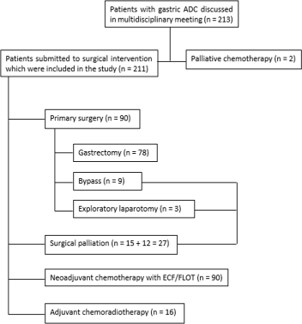
Figure 1: Flowchart of patients included in the study.
Patient allocation to multimodal therapy during the study period was non-randomized, with the primary strategy being the ECF/FLOT regimen. Thus, the group selected for treatment according to the Intergroup-0116 trial included patients under staged preoperatively or those unfit to complete neoadjuvant therapy at the time of therapeutic decision.
All procedures and therapeutic acts were performed according to the ethical standards of the institutional committee and the Declaration of Helsinki of 1964 and its subsequent amendments. Individual informed and consented agreement was obtained before each procedure.
Objectives
The primary objective included projecting and calculating the 5-year survival curves for the global sample of patients undergoing gastrectomy with curative intent, with or without chemotherapy, and comparing survival with the surgical palliation group, which was used as a control group since this strategy, by definition, does not influence survival.
It was also intended to delineate the differences in expected 5-year survival among patients undergoing different curative regimens included in this study.
Secondary objectives included comparing the extent of lymphadenectomy and the number of lymph nodes isolated with observed survival.
Statistical analysis
Data analysis was performed using SPSS version 23.
The Shapiro-Wilk test was applied to all variables to assess normality. Categorical variables were expressed as absolute values and percentages and compared using the chi-square test (post-hoc with Bonferroni correction), while continuous variables were expressed as mean±standard deviation or median (minimum-maximum), depending on distribution, and compared using analysis of variance (ANOVA) with Fisher’s post-hoc test or, for non-parametric variables, the Kruskal-Wallis test with Dunn’s post-hoc test.
Survival analysis was conducted using Kaplan-Meier estimates, complemented by comparison of survival curves using the log-rank (Mantel-Cox) test to determine statistically significant differences.
A p-value < 0.05 was considered statistically significant.
Results
Of the 211 patients included and operated on between 2017 and 2022, 79(37.4%) were female and 132(62.6%) male. Distribution among therapeutic options showed no relation to gender (χ²(1, N=211) = 5.849, p=0.211).
The mean age was 69.96 ± 11.4 years; however, age distribution across groups was asymmetric (F(3,206) = 9.195, p<0.01). Post-hoc Fisher test showed that only patients undergoing primary gastrectomy differed from others, presenting a higher mean age, while the other groups did not differ among themselves.
As for tumor location, anatomical sites considered were: antrum (60.2%), body (22.3%), fundus (12.8%), and gastroesophageal junction (Siewert type III) (4.7%), with no significant relationship between location and group distribution (χ²(9, N=211) = 16.197, p=0.063).
Surgical intervention had a median duration of 180 minutes (range 20-434), with significant differences between groups (H(3, N=211) = 45.840, p<0.01). Dunn’s post-hoc test revealed that operative time for surgical palliation was significantly shorter than other groups. Conversely, hospital length of stay averaged 13.0±12.4 days, with no differences between groups (F(3,199) = 1.737, p=0.161).
Regarding disease stage (AJCC 7th edition), 58 (31.7%) patients were stage I, 43 (23.5%) stage II, 55 (30.1%) stage III, and 27 (14.7%) stage IV. Therapeutic decision differed significantly by stage (χ²(9, N=183) = 110.656, p<0.01). After Bonferroni correction, a significantly larger proportion of stage I patients underwent primary surgery, while stage IV patients were more often assigned to surgical palliation.
Regarding lymphadenectomy, patients undergoing surgical palliation were excluded from this analysis. D2 lymphadenectomy was performed in 49.7% (n=88) of cases. Statistical evaluation showed no significant difference in the extent of lymphadenectomy relative to the therapeutic strategy applied (χ²(6, N=177) = 12.423, p=0.053). Follow-up (mean 22±19.1 months) was significantly shorter for the surgical palliation group (p<0.01), related to a higher all-cause mortality (mean 35.1%, n=74) proportional to this group (χ²(3, N=211) = 22.953, p<0.01). Operative mortality (death within 30 days post-surgery) was 1.9% (n=4). These findings are summarized in Table 1.
Table 1: Sample characteristics.
| Total sample | Surgical palliation | Primary gastrectomy | ECF/FLOT | Intergroup 0116 | p | |
|---|---|---|---|---|---|---|
| N | 211 | 27 | 78 | 90 | 16 | |
| Women | 79 (37.4%) | 7 (25.9%) | 35 (44.9%) | 28 (31.1%) | 6 (37.5%) | 0.211 |
| Men | 132 (62.6%) | 20 (74.1%) | 43 (55.1%) | 62 (68.9%) | 10 (62.5%) | |
| Age (years) | 69.96 ±11.4 | 69.3 ±15.9 | 74.7 ±10.4 | 67.3 ±9.4 | 62.7 ±9.4 | <0.01 |
| Location Antrum Body Fundus GEJ |
127 (60.2%) 47 (22.3%) 27 (12.8%) 10 (4.7%) |
23 (85.2%) 2 (7.4%) 2 (7.4%) 2 (7.4%) |
49 (62.8%) 15 (19.2%) 10 (12.8%) 4 (5.1%) |
43 (47.8%) 28 (31.2%) 13 (14.3%) 6 (6.7%) |
12 (75%) 2 (12.5%) 2 (12.5%) 0 |
0.063 |
| Procedure time (min) | 180 (20-434) | 72 (20-261) | 186 (60-347) | 192 (44-434) | 208 (141-281) | <0.01 |
| Hospital stay (days) | 13.0 ±12.4 | 10.0 ±6.1 | 14.4. ±12.9 | 13.6 ±13.9 | 8.1 ±2.15 | 0.161 |
| Staging N I II III IV |
183 58 (31.7%) 43 (23.5%) 55 (30.1%) 27 (14.7%) |
16 1 (6.2%) 15 (93.8%) |
76 34 (44.8%) 15 (19.7%) 19 (25%) 8 (10.5%) |
75 24 (32%) 24 (32%) 23 (30.7%) 4 (5.3%) |
16 0 4 (25%) 12 (75%) 0 |
<0.01 |
| Lymphadenectomy N D0 D1 D2 |
177 27 (15.3%) 62 (35.0%) 88 (49.7%) |
76 18 (23.6%) 29 (38.2%) 29 (38.2%) |
81 7 (8.6%) 25 (30.9%) 49 (60.5%) |
16 1 (6.2%) 6 (37.5%) 9 (56.3%) |
0.053 | |
| Follow-up (meses) | 22 ±19.1 | 8.1 ±10.8 | 24.7 ±20.5 | 22 ±18.9 | 32.4 ±17.1 | <0.01 |
| All-cause mortality | 74 (35.1%) | 19 (70.4%) | 22 (28.2%) | 27 (30%) | 6 (37.5%) | <0.01 |
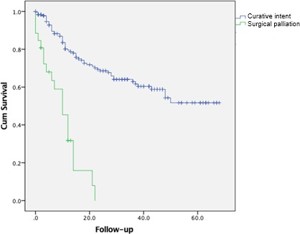
Figure 2: Kaplan-Meier survival function according to therapeutic intent.
The first survival function evaluation aggregated the three groups with curative intent primary surgery, perioperative chemotherapy and surgery, and adjuvant chemoradiotherapy patients. In this combined group, median survival was not reached, meaning survival exceeded 50% at all follow-up points, with an overall 5-year survival of 53%. The group with non-curative surgical intent had a median survival of 10.0 months (95% CI 6.34-13.66) (p<0.01) (Figure 2).
Survival analysis by therapeutic strategy showed that median survival was not reached for primary surgery and neoadjuvant ECF/FLOT groups. The Intergroup-0116 group, treated with adjuvant Macdonald regimen, had a median survival of 48.0 months (95% CI 20.08-75.92) (Figure 3).
At 60 months, the cumulative survival proportions were: 65% for primary surgery, 52% for ECF/FLOT, 24% for Intergroup-0116, and 0% for surgical palliation. The log-rank test indicated a statistically significant difference between groups (p<0.01).
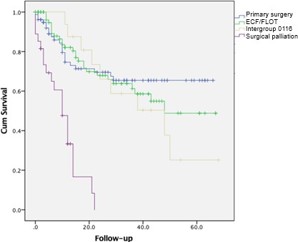
Figure 3: Kaplan-Meier survival function according to therapeutic strategy.
The initial disease stage also significantly affected survival. The observed 5-year survival rates were 87% for stage I (median not reached), 61% for stage II (median not reached), 20% for stage III (median 18 months, 95% CI 8.52-27.48), and 8% for stage IV (median 12 months, 95% CI 6.31-17.69) (p<0.01) (Figure 4).
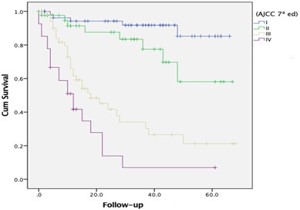
Figure 4: Kaplan-Meier survival function according to staging (AJCC 7th edition).
Although tumor characteristics, specifically the degree of local invasion, appeared to affect survival as expected (p<0.01) (Figure 5A), lower nodal metastasis (p=0.243) (Figure 5B) and extent of lymphadenectomy (p=0.338) did not confer a significant survival advantage in this sample (Figure 6).
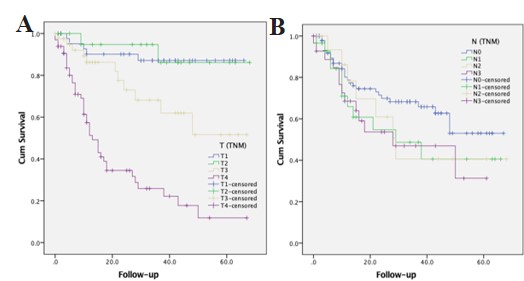
Figure 5: (A) Kaplan-Meier survival function according to tumor size (TNM). (B) Kaplan-Meier survival function according to lymph node metastasis (TNM).
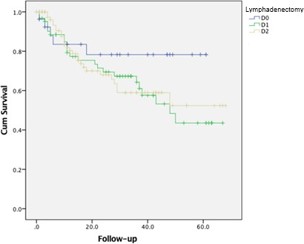
Figure 6: Kaplan-Meier survival function according to type of lymphadenectomy.
Discussion
This study evaluated 5-year survival outcomes in patients with gastric adenocarcinoma undergoing different treatment strategies at a tertiary university hospital under a dedicated multidisciplinary esophago-gastric pathology team. The results show that, as observed globally, survival remains relatively low and highly dependent on disease extent at diagnosis [16].
In our sample, overall 5-year survival was 53%, while in Japan, Katai et al. reported a 71.1% 5-year survival in a cohort of 100,000 patients undergoing surgical resection between 2001 and 2007. However, when comparing only total gastrectomy patients (n=35,000), survival rates were similar to ours, at 54.0% [17].
Declarations
Ethical considerations: All procedures were carried out in accordance with the requirements set forth by the institutional ethics committee, as well as those outlined in the 1964 Declaration of Helsinki and its subsequent amendments.
Before each procedure, individual, free, informed, and clarified consent was obtained from each patient.
Conflicts of interest: None of the authors have any conflicts of interest to declare.
References
- Lin Y, Zheng Y, Wang HL, Wu J. Global Patterns and Trends in Gastric Cancer Incidence Rates (1988-2012) and Predictions to 2030. Gastroenterology. 2021; 161: 116-27
- Sung H, Ferlay J, Siegel RL, et al. Global Cancer Statistics 2020: GLOBOCAN Estimates of Incidence and Mortality Worldwide for 36 Cancers in 185 Countries. CA Cancer J Clin. 2021; 71: 209-49.
- Morgan E, Arnold M, Camargo MC, et al. The current and future incidence and mortality of gastric cancer in 185 countries, 202040: A population-based modelling study. EClinicalMedicine. 2022; 47: 101404
- Rawla P, Barsouk A. Epidemiology of gastric cancer: global trends, risk factors and prevention. Prz Gastroenterol. 2019; 14: 26-38.
- Ferlay J, Ervik M, Lam F, Colombet M, Mery L, Piñeros M, Znaor A, et al. Global Cancer Observatory: Cancer Today. Lyon, France: International Agency for Research on Cancer. 2020.
- Karimi P, Islami F, Anandasabapathy S, Freedman ND, Kamangar F. Gastric cancer: descriptive epidemiology, risk factors, screening, and prevention. Cancer Epidemiol Biomarkers Prev. 2014; 23: 700-713.
- Longo D, Fauci A, Kasper D, Hauser S, Jameson J, Loscalzo J. Harrison´s principles of internal medicine. 18th edition. United States of America: The McGraw-Hill Companies. Chapter 91, Gastrointestinal Tract Cancer. 2011: 765-68.
- Tanaka K, Kiyohara Y, Kubo M, et al. Secular trends in the incidence, mortality, and survival rate of gastric cancer in a general Japanese population: the Hisayama study. Cancer Causes Control. 2005; 16: 573-78.
- Ilic M, Ilic I. Epidemiology of stomach cancer. World J Gastroenterol. 2022; 28: 1187-1203.
- Kundel Y, Purim O, Idelevich E, et al. Postoperative chemoradiation for resected gastric cancer--is the Macdonald Regimen Tolerable? a retrospective multi-institutional study. Radiat Oncol. 2011; 6: 127.
- Macdonald JS, Smalley SR, Benedetti J, et al. Chemoradiotherapy after surgery compared with surgery alone for adenocarcinoma of the stomach or gastroesophageal junction. N Engl J Med. 2001; 345: 725-30.
- Smalley SR, Benedetti JK, Haller DG, et al. Updated analysis of SWOG-directed intergroup study 0116: a phase III trial of adjuvant radiochemotherapy versus observation after curative gastric cancer resection. J Clin Oncol. 2012; 30: 2327-33.
- Cunningham D, Allum WH, Stenning SP, et al. Perioperative chemotherapy versus surgery alone for resectable gastroesophageal cancer. N Engl J Med. 2006; 355: 11-20.
- Bradley CA. Perioperative FLOT superior to ECF/X. Nat Rev Clin Oncol. 2019; 16: 465.
- Hawkes N. Cancer survival data emphasise importance of early diagnosis. BMJ. 2019; 364: l408.
- Li Y, Feng A, Zheng S, Chen C, Lyu J. Recent Estimates and Predictions of 5-Year Survival in Patients with Gastric Cancer: A Model-Based Period Analysis. Cancer Control. 2022; 29: 10732748221099227.
- Katai H, Ishikawa T, Akazawa K, et al. Five-year survival analysis of surgically resected gastric cancer cases in Japan: a retrospective analysis of more than 100,000 patients from the nationwide registry of the Japanese Gastric Cancer Association (2001-2007). Gastric Cancer. 2018; 21: 144-54.