Journal of
Clinical & Medical Surgery
Clinical & Medical Surgery
www.jclinmedsurgery.com
ISSN 2833-5465
Open Access
Volume 5
Open Access
Volume 5
Ananya Das1*; Megha Goyal1; D Khongwar2; Himen Baidya2; Suhita Prajapati3
*Corresponding Author: Ananya Das
Department of Obstetrics & Gynaecology, North Eastern Indira Gandhi Regional Institute of Health & Medical Sciences (NEIGRIHMS), Mawdiangdiang, Shillong-793018, Meghalaya, India.
Email: mailmedrananyadas@rediffmail.com
Article Info
Received: Feb 14, 2025
Accepted: Mar 06, 2025
Published: Mar 13, 2025
Archived: www.jclinmedsurgery.com
Copyright: © Das A (2025).
Abstract...
Background: Etonogestrel implant is a subdermal contraceptive implant that is classified as a long-acting reversible contraceptive. In situ breakage of Implant is a rare occurrence with unknown clinical significance. Here is one unusual case of women who attended our hospital.
Discussion: There can be symptomatic or asymptomaric breakage of implants in situ, but the real impact on contraceptive efficacy or bleeding is uncertain. Even more, it can be argued if, as a result of an occurrence of that nature, the implant shall or shall not be removed before the envisaged 3-year period of effectiveness.
Conclusion: Currently, the clinical significance of implant breakage remains unknown. The decision to remove a broken or bent implant should be based on clinical judgements considering patients’ wishes.
Keywords: Contraceptive; Etonogestrel; Hormonal; Implant; Broken.
Citation: Das A, Goyal M, Khongwar D, Baidya H, Prajapati S. A Case Report on In Situ Breakage of Etonogestrel Implant- A Rare Occurance. J Clin Med Surgery. 2025; 5(2): 1184.
Introduction
Long active highly effecticve contraception which are reversible is provided by contraceptive implants [1-4]. Etonogestrel Implant is a flexible rod composed of Ethylene Vinyl Acetate (EVA) solid core with crystals of etonogestrel imbedded within the core [3,4]. Surrounding the core is a thin layer of EVA (0.06 mm thick) which controls the release rate of etonogestrel [1,2]. The ends of the rod do not contain this rate-controlling membrane. Etonorgestrol is initially released from these which rapidly reaches its therapeutic serum levels [1,2]. These implants which are single rod are 4 cm in length and 2 mm in diameter. Their package comes preloaded with sterile applicator which are sterile [3]. It is not radiopaque or biodegradable.
Etonogestrel Implant is approved for 3 years of use at present. Its easy to insert implant and also remove and also providing excellent efficacy [3,4]. It is a good contraceptive option for women with contraindications to combined hormonal methods and who seek for long-term contraception [3,4]. Breakage of etonorgestrel implants being in situ is very rare and its clinical significance is unknown [1,2]. Here is one unusual case of women who attended our hospital.
Case report
A 24-year-old female P1L1A2 presented for Etonogestrel implant removal. The rod was placed 6 months earlier post abortion in June 2024. Rod was inserted using standard technique in the non-dominant arm. No complications occurred. Following insertion of implant patient gave history of ammenorhoea. Patient had an unremarkable history. Patient had history of lifting heavy bucket while doing household work following which she felt that the device was bent. On examination etonorgestrel implant could be palpated but a central concavity could be felt and there was a breech in continuity of implant. The patient wanted removal of the implant. Following the guidelines by manufacturer the implant was removed (Figures 1 & 2). Prior to removal of implant urine pregnancy test was done which was negative. There was a break in etonorgestrel rod at the distal one- third with a noticeable breach in continuity (Figure 3). Procedure was tolerated well by patient without any complications.
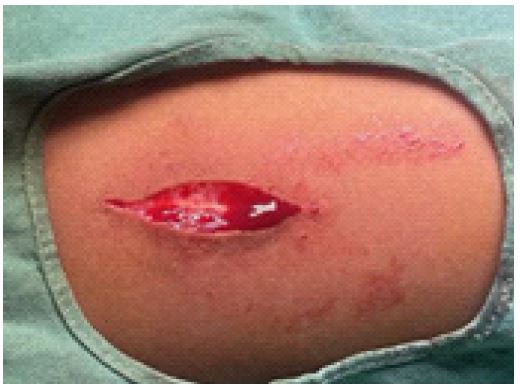
Figure 1: Clinical image
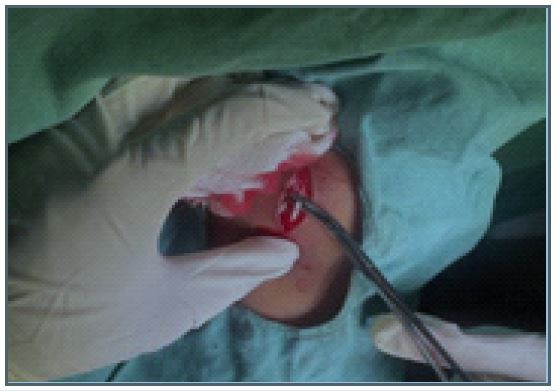
Figure 2: Clinical image
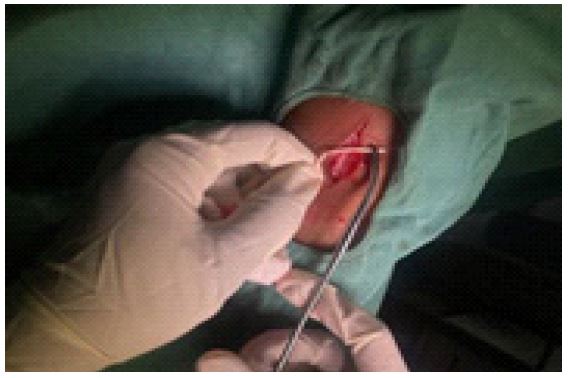
Figure 3: Clinical image
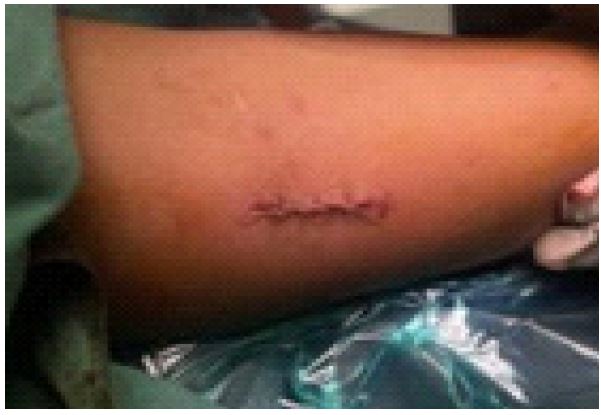
Figure 4: Clinical image
Discussion
There may occur release rate variation in etonorgestrel if the implant breaks or its membrane gets fractured [5]. There was some material which was not published provided by manufacturer which stated that implants were damaged intentionally during the stages of development to evaluate their rate of release in vitro [5]. It was verified during those experiences that there was increase in rate of release of etonorgestrel as compared to undamaged implants [5]. It was concluded by investigators that these small damages caused minimal influence on the rate of release and no major changes in pharmacokinetics. There is however a possibility that there can be release rate mechanism failure due to disruption of rods which are specially designed. This can lead to a variable serum concentration of etonogestrel. So, there could be change in the previous bleeding pattern or a reduction in the method’s efficacy in theory due to this [1,2,6].
In the literature, there are only four cases described of broken implant before removal [1,2,6]:
(a) Pickard and Bacon reported a case of in situ breakage of a contraceptive implant in a woman who was 29 years old. There was persistent, prolonged vaginal bleeding which required medical care. There was history of implant insertion 2 years back. Patient was satisfied with with the implant and there was amenorrhea with sometimes light menses. During a game of “rough and tumble” with her 7 year son probably this patient’s implant was broken. The device was removed. There was a fracture halfway its width after close observation. A new Implant device was therefore inserted, with a fast loss of symptoms [2].
(b) Tomás Tello and Hodgson reported two cases of broken Implanon®. There was history of trauma on the arm repeatedly in both the cases, and Implanon®’s breakage resulted in abnormal menstrual bleeding [6]. The two above-mentioned events were the only ones reported which concerned broken or bent Implanons®.
(c) Agrawal and Robinson reported a case of a 30-year-old woman presented with a broken Implanon® without associated trauma. This patient reported no changes in her symptomatology except that menstrual bleeding had become heavier [1].
Conclusion
Our patient was asymptomatic and satisfied with the contraceptive device but wanted to remove the implant as it was broken. One needs to point out that further investigation is required to fully understand the clinical impact of Implanon’s breakage. Until then, patients should be advised to notify their healthcare providers in case of implant breakage. In case of broken, bent or compromised implants removal of the same is recommended. But the decision of removal of implant should always rely both on patient’s desire and clinical judgement.
References
- Agrawal A, Robinson C. Spontaneous snapping of an Implanon® in two halves in situ. J Fam Plann Reprod Health Care. 2003; 29: 238.
- Pickard S, Bacon L. Persistent vaginal bleeding in a patient with a broken Implanon®. J Fam Plann Reprod Health Care. 2002; 28: 207–8.
- ACOG Practice Bulletin. Long-acting reversible contraception: implants and intrauterine device. Clinical management guidelines for obstetrician–gynecologist. Obstet Gynecol. 2011; 121: 184–96.
- Fisher MA. Implanon: a new contraceptive implant. J Obstet Gynecol Neonatal Nurs. 2008; 37: 361–8.
- Torres Rita, Mendes Neuza, Machado Ana, Marques Carlos. In situ breakage of Implanon (R) - two cases of a rare occurrence. Contraception. 2012: 88.
- Tomás-Tello MD, Hodgson GG. Two cases of broken Implanon ®. J Fam Plann Reprod Health Care. 2010; 36: 255.